
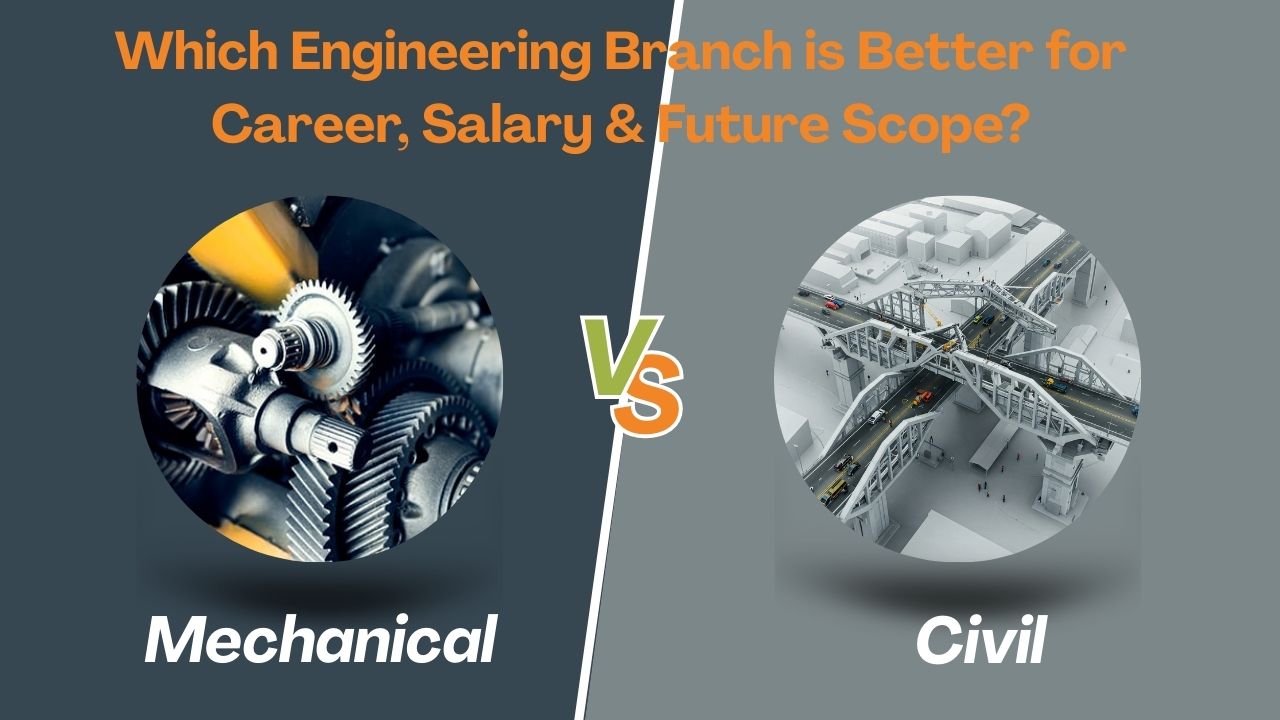
This article will mainly focus on the Mechanical vs Civil. It will also show which engineering branch is better for career, salary and Future Scope. A solid background in math and physics is necessary for both mechanical and civil engineering, usually beginning with a bachelor’s degree. But each field has a slightly different path to specialization and mastery.
Also learn: ECE vs CSE
Mechanical vs Civil: Which Engineering Branch is Better for Career, Salary & Future Scope?
In the field of engineering, mechanical engineers are frequently praised for their versatility. They focus on automation, robotics, and engine design, among other things. In contrast, civil engineers are responsible for the construction of our physical environment, including skyscrapers, roads, bridges, and water systems.
The roles of civil and mechanical engineers are changing in a world that is changing quickly due to population expansion, climate change, and technological improvements. However, the issue still stands: which field—civil engineering or mechanical engineering—has a brighter future? You can make an informed choice by using this detailed comparison to help you go through the facts.
Mechanical vs Civil: Which Engineering Branch is Better for you?
| Feature | Mechanical Engineering | Civil Engineering |
|---|---|---|
| Focus Area | Machines, systems, robotics | Infrastructure, buildings |
| Average Salary | Slightly Higher | Slightly Lower |
| Work Environment | Mostly Indoor | Indoor + Field |
| Top Growth Areas | EVs, AI, Robotics | Smart Cities, Sustainability |
| Global Demand | High | High |
| Career Flexibility | Broader | More Specialized |
| Job Stress Level | Medium | Medium-High |
Mechanical vs Civil: Career Path
| Feature | Mechanical Engineering Career Path | Civil Engineering Career Path |
|---|---|---|
| Industries | Automotive, Aerospace, Defence, Robotics, Energy, Biomedical | Construction, Public Works, Transportation, Water Management |
| Common Roles |
|
|
| Career Growth | Many mechanical engineers also move into managerial or entrepreneurial roles after gaining industry experience. | Civil engineers are frequently employed by government agencies, making this a stable career option with plenty of room for impact and innovation. |
Mechanical vs Civil: Salary Comparison
| Country | Mechanical Engineer Avg. Salary | Civil Engineer Avg. Salary |
|---|---|---|
| India | INR 6,00,000 per year | INR 5,00,000 per year |
| USA | INR 70,00,000 per year (approx.) | INR 66,00,000 per year (approx.) |
| UK | INR 37,00,000 per year (approx.) | INR 34,00,000 per year (approx.) |
| Australia | INR 53,00,000 per year (approx.) | INR 50,00,000 per year (approx.) |
| Canada | INR 49,00,000 per year (approx.) | INR 46,00,000 per year (approx.) |
Note: These numbers are estimates based on wage surveys and current exchange rates. Job role, geography, and experience all affect actual earnings.
Mechanical vs Civil: Educational Requirements
A solid background in math and physics is necessary for both mechanical and civil engineering, usually beginning with a bachelor’s degree. But each field has a slightly different path to specialisation and mastery.
| Feature | Mechanical Engineering | Civil Engineering |
|---|---|---|
| Undergraduate Core Subjects | Dynamics, Thermodynamics, Heat Transfer, Machine Design, Control Systems | Structural Analysis, Soil Mechanics, Hydrology, Transportation Engineering |
| Undergraduate Labs & Projects | Prototyping, simulations, and thermal systems | Design projects, surveying labs, and construction management |
| Postgraduate Specializations | Mechatronics, Automotive Engineering, Energy Systems, Nanotechnology | Structural Engineering, Water Resources, Environmental Engineering, Urban Planning |
Mechanical vs Civil: Key areas to Work
There are many different fields in which mechanical engineers can work. The field of civil engineering encompasses many different types of work. The main sectors and regions in which both type of Engineers usually operate are broken down as follows.
| Key Areas of Work in Mechanical Engineering | Key Areas of Work in Civil Engineering |
|---|---|
| Automotive Industry – Designing and testing vehicle components, improving fuel efficiency, and ensuring safety standards. | Structural Engineering – Design and analysis of buildings, bridges, and towers. |
| Aerospace – Developing aircraft systems, spacecraft, and satellites. | Transportation Engineering – Planning and development of highways, railways, and airports. |
| Manufacturing and Production – Overseeing factory equipment, quality control, and improving efficiency through lean manufacturing. | Environmental Engineering – Managing pollution, waste treatment, and sustainability. |
| Energy Sector – Optimising power stations or working on renewable energy sources like wind and solar. | Water Resources Engineering – Design of dams, canals, and flood control systems. |
| Robotics and Automation – Designing smart robots for industrial and medical applications. | Urban Planning – Designing livable, efficient, and sustainable cities. |
| HVAC Systems – Designing and maintaining heating, ventilation, and air conditioning systems in buildings. | Construction Management – Overseeing project execution, safety, and budgeting. |
Mechanical engineers can also pursue interdisciplinary careers in mechatronics, nanotechnology, and even biomedical engineering because of their versatility.
Mechanical vs Civil: Core Subjects Involved
| Core Subject of Mechanical Engineering | Core Subject of Civil Engineering |
|---|---|
| Thermodynamics | Structural engineering |
| Mechanics | Geotechnical engineering |
| Fluid dynamics | Transportation engineering |
| Materials science | Environmental engineering |
| Computer-aided design (CAD) | Construction management |
| Robotics and automation | Hydraulics and water resources |
| Heat transfer | Urban planning |
Essential Tools, Instruments and Technologies
In Mechanical Engineering
Mechanical engineers mostly depend on technologies and software to expedite their work in the digital age. Among the important technologies are:
- CAD (Computer-Aided Design): 3D modelling and mechanical part design are done with programs like AutoCAD and SolidWorks.
- The process of simulating a product’s response to actual forces, vibrations, heat, and other physical impacts is known as finite element analysis, or FEA.
- IoT and Sensors: Used in smart systems and automation operations.
- 3D printing and prototyping: Testing and development can proceed more quickly with rapid prototyping.
- For numerical computation and dynamic system modelling, use MATLAB and Simulink.
- Programming robotics involves integrating hardware to manage robotic systems.
To remain competitive in the market, it is essential to comprehend and become proficient using these technologies.
In Civil Engineering
- Draughting and detailing layouts and constructions requires the use of AutoCAD and Civil 3D. AutoCAD’s capabilities is expanded with civil-specific features in Civil 3D.
- Geographic Information Systems, or GIS, are used in environmental engineering and urban planning for mapping and spatial analysis.
- Building Information Modelling (BIM): Architects, engineers, and contractors can work together more effectively thanks to platforms like Revit that enable integrated design and documentation.
- Software for environmental simulation: programs such as SWMM for modelling urban drainage or HEC-RAS for river study.
- Engineers can model and simulate forces, load-bearing structures, and overall integrity with the aid of structural analysis programs like SAP2000 and STAAD.Pro.
- Project management software such as Primavera P6 and Microsoft Project are essential for risk management, scheduling, and resource allocation.
FAQs on the Mechanical vs Civil
Which is simpler to learn mechanical or civil engineering?
Depending on your interests, mechanical leans more towards physics and machines, while civil is more field and design focused.
Which engineering field is more suitable for government employment?
The answer is that civil engineering frequently fits in better with public works initiatives and government infrastructure.
Is it possible for a mechanical engineer to do construction work?
Yes, particularly when it comes to HVAC, building supplies, or equipment.
Will AI take the place of civil or mechanical engineers?
AI is improving, not replacing, the answer. Instead of disappearing, both disciplines are changing along with technology.
Which is the higher paying field, civil or mechanical?
In general, mechanical engineers make a little more money, particularly in high-tech fields.