
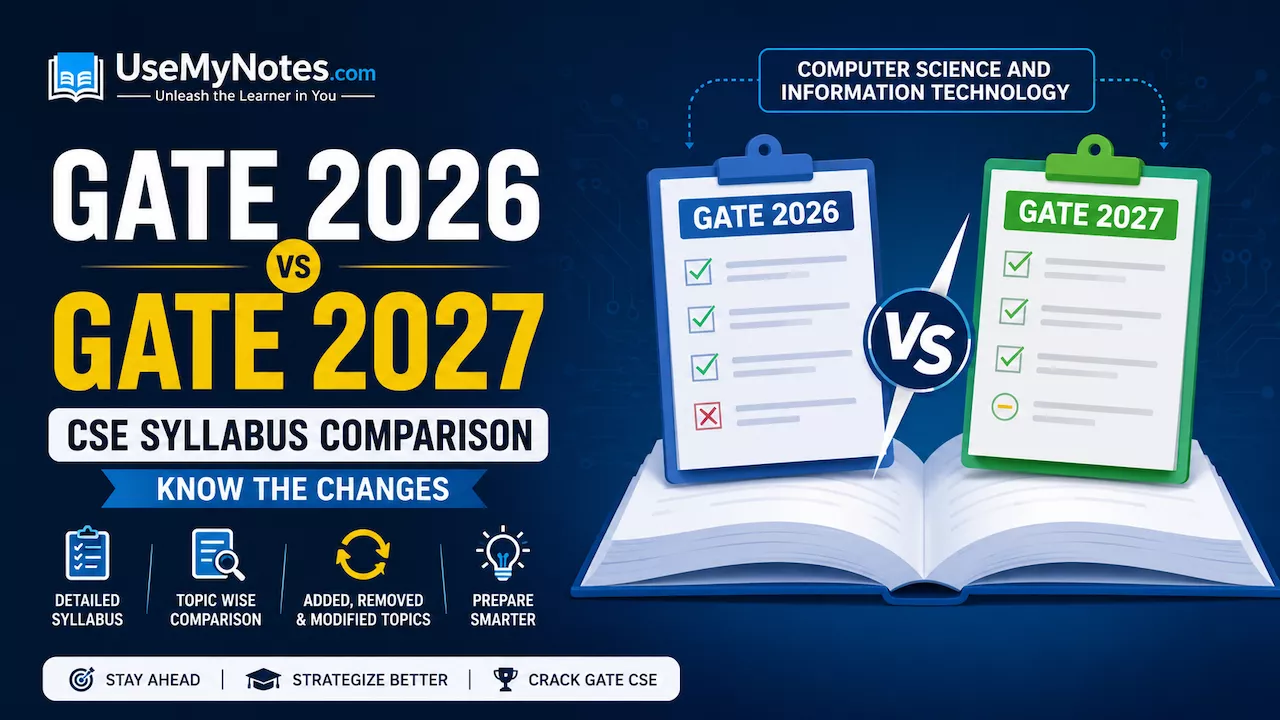
This article will mainly talk about the GATE 2026 vs 2027 CSE Syllabus Comparison: Know the Changes. Compared with GATE 2026, the official GATE 2027 Computer Science & Information Technology (CS) syllabus published by IIT Madras includes specific revisions and rewording of topics. Knowing these changes ensures that you focus your preparation on current topics while omitting irrelevant information.
GATE 2026 vs 2027 CSE Syllabus Comparison: Know the Changes
Download GATE CSE study material for free
The launch of Robotics and Automation (RA) as a new GATE paper is the largest announcement of the year.
- RA is now an option for second papers for students in Computer Science (CS), Data Science & Artificial Intelligence (DA), Mechanical Engineering (ME), and Electrical Engineering (EE).
- Many students are unsure if they should choose DA + RA or CS + RA.
- The RA syllabus covers many courses from Mechanical and Electrical Engineering, so while these pairings are permitted, they might not be the best option for everyone.
| Section | Change | Notes |
|---|---|---|
| 1. Engineering Mathematics | No change | Discrete Math, Probability & Statistics are identical, Linear Algebra, Calculus. |
| 2. Digital Logic | Changed | All Minimisation methods are now explicit: Karnaugh map, algebraic technique, tabular method. Added “Design of” for circuits. “Number representations and computer arithmetic” becomes “Number representation and arithmetic”. |
| 3. Computer Organization & Architecture | Changed | “Machine instructions” is now “Instruction set”. ALU/control unit are design-focused (“Design of arithmetic and logic unit”, “Design of control unit – hardwired and microprogrammed”). Memory hierarchy wording changed. “DMA mode” is now just “DMA”. |
| 4. Programming & Data Structures | No change | Programming in C, recursion, arrays, stacks, queues, linked lists, trees, BSTs, heaps, graphs. |
| 5. Algorithms | No change | Searching, sorting, hashing, complexity, greedy, dynamic programming, divide-and-conquer, graph algorithms. |
| 6. Theory of Computation | No change | Regular expressions, finite automata, CFGs, PDAs, pumping lemma, Turing machines, undecidability. |
| 7. Compiler Design | No change | Lexical analysis, parsing, data-flow analyses, runtime environments, IR creation, and syntax-directed translation. |
| 8. Operating Systems | No change | IPC, concurrency, deadlocks, scheduling, virtual memory, file systems, system calls, processes, and threads. |
| 9. Databases | No change | SQL, algebra, tuple calculus, ER model, relational model, integrity constraints, normal forms, indexing, and transactions. |
| 10. Computer Networks | Major change | The syllabus for 2027 is shorter. OSI and TCP/IP stacks, framing, Ethernet bridging, shortest-path/flooding routing, ARP/DHCP/ICMP, UDP, SMTP/FTP, and email were eliminated. Principles of layering, switching fundamentals with performance measurements, error detection, MAC, Ethernet, distance-vector/link-state routing, IPv4 fragmentation/CIDR/NAT, TCP flow/congestion control, socket API, DNS, and HTTP were kept. |
GATE 2026 vs 2027 CSE Syllabus Executive Summary
The curriculum for GATE CS 2027 is essentially unchanged or unaltered. Only a few specific revisions are needed, and the current preparation materials are still beneficial. Please find the below table as the executive summary.
| Category | Summary |
|---|---|
| Sections Changed | Three of the ten technical sections-Digital Logic, Computer Networks, and Computer Organization & Architecture (COA)-were modified. |
| Sections Unchanged | Approximate 7 Technical Sections and some General Aptitude qustions remain 100% identical. |
| Newly Explicit Topics | Karnaugh Maps (K-Maps), the Tabular Method, Hardwired Control, Microprogrammed Control, and other issues are specifically mentioned. |
| Topics No Longer Explicitly Mentioned | Nine topics-UDP, ARP, DHCP, ICMP, SMTP, FTP, Email, Flooding, and Shortest Path—were eliminated from explicit discussion. |
What actually changed?
| Category | Details |
|---|---|
| Changed |
|
| Unchanged |
|
Are these changes relevant?
Instead of introducing completely new themes, the majority of modifications restructure or clarify already-existing ones. Computer Networks has seen the biggest modifications, while Computer Organization & Architecture now specifically mentions a number of implementation-level subjects.
Subjects No Longer Specifically Discussed
By going over the subjects that are no longer specifically covered under Computer Networks, candidates can simplify their revision list:
- Transport Layer: Only TCP and socket API are left; User Datagram Protocol (UDP) is no longer specifically specified.
- IP Support Protocols: ICMP, DHCP, and ARP are no longer specifically addressed.
- Application Layer Protocols: Only DNS and HTTP are still stated; SMTP, FTP, and email are no longer specifically referenced.
- Routing Mechanisms: Distance Vector and Link State are still used, although Flooding and Standalone Shortest Path routing are no longer specifically addressed.
- Data Link Layer: “Ethernet” is used instead of “Framing” and “Ethernet bridging.”
GATE CSE 2027 – No Subject Changes
Most of the Core Subjects are Unchanged, so if the students are already preparing for the GATE CSE 2027, no need to worry and can continue their preparation.
| Core CSE Subject | Status in GATE 2027 |
|---|---|
| Engineering Mathematics | No change |
| Programming & Data Structures | No change |
| Algorithms | No change |
| Discrete Mathematics | No change |
| Database Management Systems | No change |
| Operating Systems | No change |
| Theory of Computation | No change |
| Compiler Design | No change |
Checklist for GATE 2027 Candidates’ Preparation
- Examine your notes against the official GATE 2027 syllabus.
- Add the newly specified implementation items to the COA notes.
- Practice tabular, algebraic, and K-Map minimization techniques.
- Examine the updated Computer Networks curriculum.
- For the remaining seven technical subjects, keep using the current content.
GATE CSE 2027 Syllabus
The below section shows the proper 10 section core subject that is the part of the GATE CSE 2027 syllabus.
| Section | Subject |
|---|---|
| Section 1 | Engineering Mathematics |
| Section 2 | Digital Logic |
| Section 3 | Computer Organization and Architecture |
| Section 4 | Programming and Data Structures |
| Section 5 | Algorithms |
| Section 6 | Theory of Computation |
| Section 7 | Compiler Design |
| Section 8 | Operating System |
| Section 9 | Databases |
| Section 10 | Computer Networks |
FAQs on the GATE 2026 vs 2027 CSE Syllabus Comparison
What significant modifications have been made to the GATE CS 2027 syllabus?
A number of topics (UDP, ARP, DHCP, ICMP, SMTP, FTP, Email, and Flooding) have been eliminated in Computer Networks, which is where the biggest changes have occurred. The remaining seven technical subjects remain the same, except Digital Logic and COA have undergone slight language changes.
Does GATE CS 2027 Computer Networks no longer use UDP?
Indeed, the Transport Layer syllabus for GATE CS 2027 no longer includes UDP. ‘TCP-flow control and congestion control, socket API’ is now specified in the syllabus.
Has the GATE 2027 General Aptitude syllabus changed?
No, the General Aptitude (GA) part syllabus for GATE 2027 is exactly the same.
Where can I find the official PDF curriculum for GATE CS 2027?
The official GATE CS 2027 syllabus PDF is available for download directly from the IIT Madras GATE 2027 portal at gate2027.iitm.ac.in.